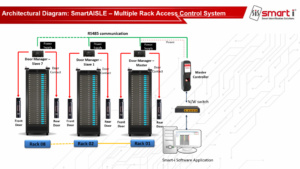
In a modern data centre, physical security does not end at the data hall entrance. Once an authorised person enters the facility, individual server racks remain an important last layer of physical protection for IT equipment and the information it supports.
Rack doors are commonly secured using traditional mechanical keys or electronic access-control arrangements. For organisations looking for stronger accountability, easier administration and rack-level visibility, an integrated electronic swing handle can offer a practical alternative.
Why Rack-Level Access Deserves More Attention
Data centres typically use multiple layers of physical security, including building access control, mantrap or room-level controls, CCTV and security procedures. Rack-level protection adds another important layer by controlling access to the cabinet that directly houses servers, networking equipment and other critical IT assets. If you’re weighing how much emphasis to place at each layer, our comparison of server rack security versus server room security breaks down why data centres need both.
At this level, the objective is not simply to keep a rack locked. Operators also need to know who was authorised to access it, when access occurred, and whether the rack is in the expected physical state. This becomes increasingly important as rack counts, operational teams, contractors and audit requirements grow.
Where Traditional Rack Locking Approaches Have Limitations
1. Mechanical Lock-and-Key
A conventional key can provide basic physical protection, but it does not inherently identify the individual using the key.
Keys may be shared, duplicated, lost or retained by former personnel, creating administrative and accountability challenges.
Unless a separate process is maintained, there is no electronic access event associated with the physical key operation.
2. Reader with Electromagnetic Lock – Key Limitations for Rack Applications
Continuous Power Dependency: Electromagnetic locks require continuous power to maintain the locked condition, making their behaviour during power interruptions an important consideration for rack security.
Fail-State Considerations: During power failure or system faults, the locking behaviour of an EM lock needs to be carefully evaluated against the security requirements of the rack.
Higher Installation Complexity: Installing an EM lock on a rack door may require additional brackets, alignment, cabling and interface components, increasing installation complexity.
Limited Rack Space: Rack doors have limited available space, making the integration of magnets, armatures, sensors and associated wiring less convenient than an integrated rack-locking mechanism.
For rack-level physical security, an integrated electronic swing-handle solution can offer a more compact, rack-specific and operationally simpler approach than an electromagnetic-lock arrangement.
How Smart-i smartSWING Addresses Rack-Level Security
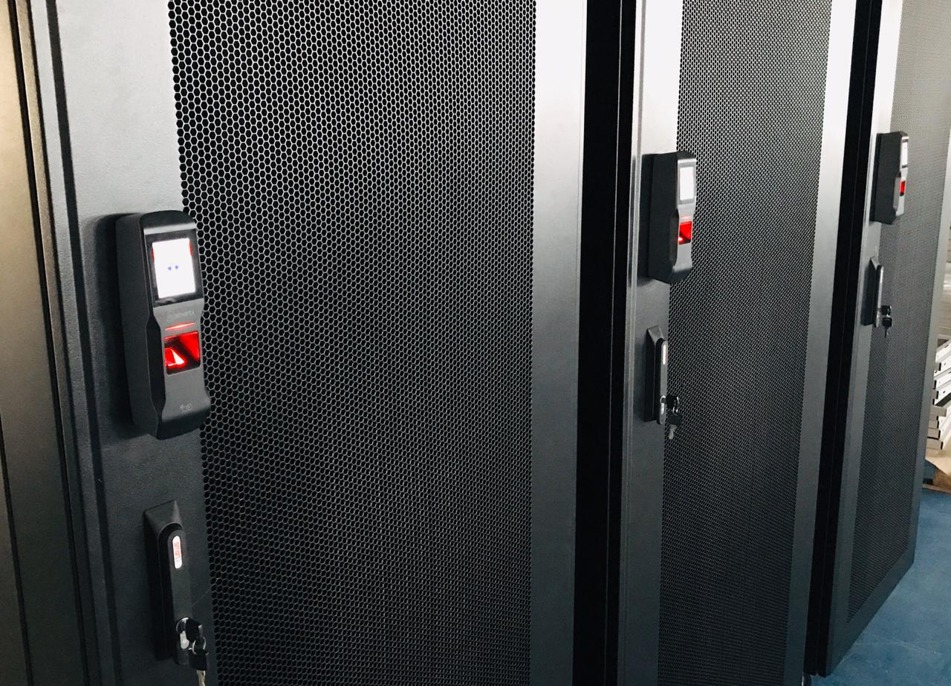
Smart-i smartSWING is an electronic swing handle lock designed specifically for server-rack applications. It combines electronic and mechanical locking functionality and can be used with biometric and card-based access-control solutions. This approach brings the locking mechanism directly into the rack-handle format, helping simplify the physical security architecture at the cabinet level, and it fits into our broader server rack automation portfolio.
- Electronic and mechanical locking functionality in a rack-mounted swing-handle format.
- Compatibility with biometric and card-based authentication as part of the access-control solution.
- Single- or multi-point lock actuation for different rack-door requirements.
- Metal handle construction designed for high strength and durability.
- RGB LED indication to show lock/handle status clearly.
- Lock/handle status sensing to provide visibility of the physical state of the mechanism.
- Mechanical key override is available, subject to the selected configuration – Common Key or Unique Key.
Lower Complexity at the Rack
For a data centre with many racks, the physical architecture of the locking solution matters. A purpose-designed electronic swing handle can reduce the need to adapt conventional door-locking hardware to a rack cabinet and can provide a cleaner, more consistent installation.
The commercial and engineering benefits will depend on the rack design, number of doors, access-control architecture, cabling method and site requirements. Therefore, total cost of ownership should be evaluated on the complete solution rather than on the lock alone — you can explore the full range of rack and data centre security products to see how the pieces fit together.
Security and Availability: Choose the Right Locking Philosophy
Fail-safe and fail-secure behaviour should not be treated as a one-size-fits-all rule. The appropriate behaviour depends on the application, applicable safety requirements, rack design and the customer’s security policy.
Unlike a simple mechanical key lock, an electronic rack-locking solution can provide controlled authentication and event visibility. At the same time, a mechanically retained swing-handle design can preserve physical latching at the cabinet. The exact behaviour during power failure should always be confirmed against the selected Smart-i product configuration and site requirements.
Why Physical Status Matters Alongside Authentication
An access event tells an operator that an authentication attempt occurred. For effective rack security, it is also valuable to know the physical status of the locking mechanism. Smart-i smartSWING incorporates status sensing and visual indication so that the lock and handle condition can be identified locally.
This distinction is important during audits, maintenance activities and incident investigations. A well-designed rack access system should correlate authorised access with the physical condition of the rack wherever the system architecture supports that level of monitoring — read more on how AI-driven analytics support this in AI-powered data centre security with biometric access control.
Human Error: Designing for Better Operational Control
Human error remains an important contributor to data-centre incidents. Uptime Institute research has reported that nearly 40% of organisations experienced a major outage caused by human error over a three-year period, with many such incidents linked to procedures or failure to follow procedures.
Rack access control cannot eliminate human error completely, but better identity management, clear status indication, consistent operating procedures and reliable event records can help data-centre teams reduce avoidable risk and investigate incidents more effectively.
Beyond the Lock: A Complete Rack Security and Monitoring Approach
Rack security is most effective when access control is considered as part of the wider data-centre monitoring architecture. Smart-i’s data-centre portfolio includes smartSWING for electronic rack locking, smartRMU-ACEM for rack access and environmental monitoring, and smartRMU-EM for environmental monitoring and alarm functions.
Depending on the project architecture, these solutions can support rack-level security together with monitoring of parameters such as temperature, humidity, smoke and water leakage, helping operators move from isolated locking devices toward a more integrated rack-management approach. For a deeper look at continuous visibility, see why 24×7 data centre monitoring matters and the role of environmental monitoring in data centre operations.
The Long-Term Test of Rack Security
The real value of a rack-security solution is measured over years, not only on installation day. Operators should consider durability, maintenance, authentication, physical status visibility, scalability, power behaviour, integration and auditability when selecting a rack-access solution.
Smart-i smartSWING is purpose-designed for rack applications and combines electronic access control with a mechanical swing-handle locking mechanism. When engineered as part of the appropriate Smart-i data-centre architecture, it can provide a practical foundation for controlled, auditable rack-level physical security.
Conclusion
Rack-level security is an important extension of data-centre physical security. Traditional keys can provide basic protection but limited accountability, while reader-and-lock arrangements can introduce additional components and design considerations.
An integrated electronic swing handle such as Smart-i smartSWING provides a rack-focused approach that combines electronic and mechanical locking, biometric/card-based access options, physical status indication and rack-suitable mechanics. The right solution should ultimately be selected based on the site’s security policy, rack design, availability requirements and overall access-control architecture.
Explore Smart-i’s complete range of data centre and server rack security solutions or visit smartisystems.com to speak with our team about your rack-level security requirements.