How Smart-i Centralises Access-Control Management While Extending Rack-Level Control Across Multiple Enclosures
As data centres scale, rack-level access control needs to provide more than authentication at an individual enclosure. It must also be practical to deploy, manage and expand across multiple racks without unnecessarily duplicating the complete access-control infrastructure at every rack.
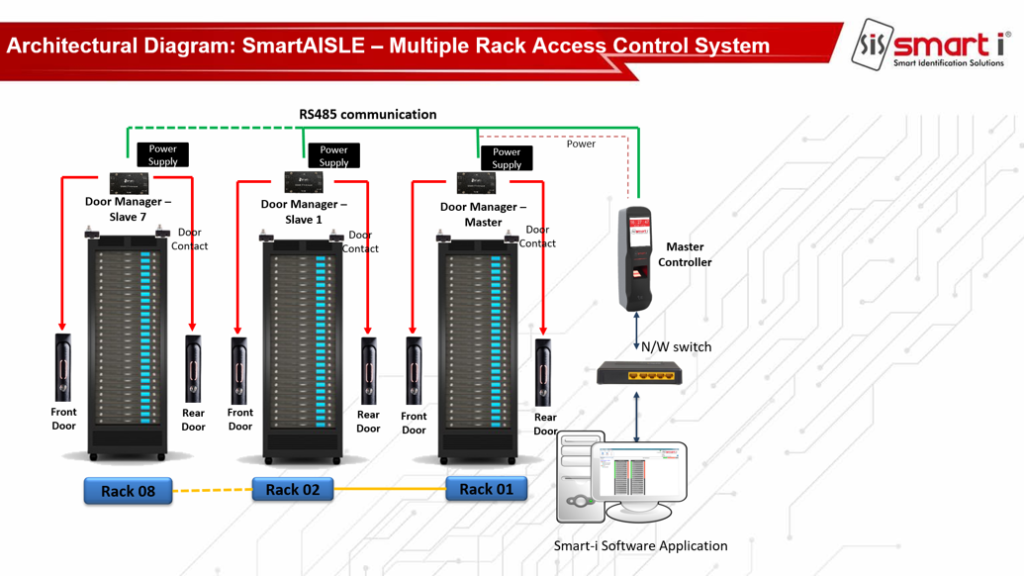
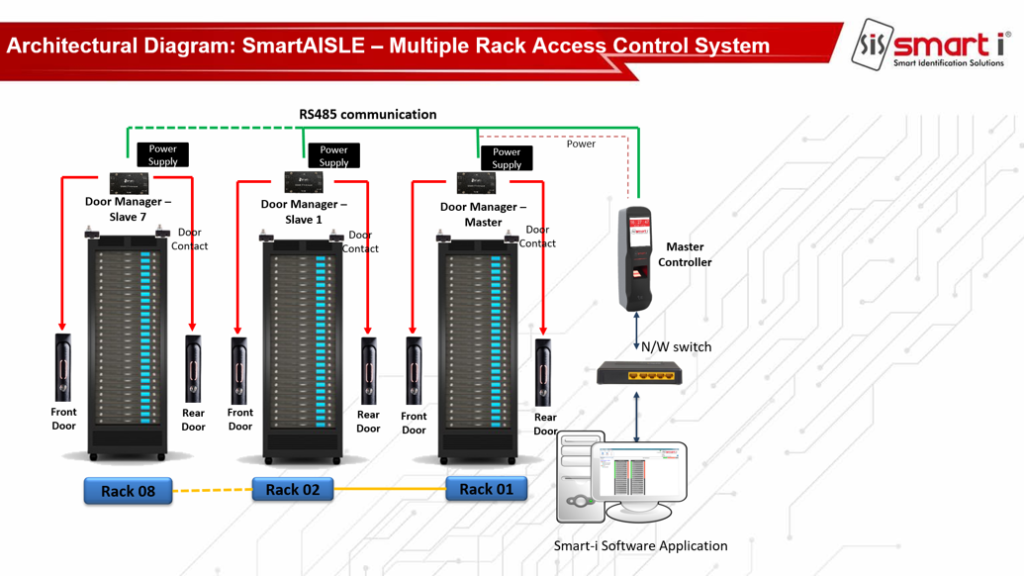
Smart-i’s SmartAISLE architecture addresses this requirement through a master-slave arrangement in which a central master controller communicates with multiple rack-level Door Manager units over RS485. This architecture enables a group of racks to be managed as a coordinated access-control system.
1. The Challenge with Scaling Rack-Level Access Control
Deploying a complete reader-and-controller arrangement at every rack can increase hardware count, cabling, power requirements, configuration effort and maintenance points. This becomes increasingly significant as the number of secured racks grows — a trade-off we explore in more depth in Server Rack Security vs. Server Room Security: Why Your Data Center Needs Both.
A scalable architecture therefore separates the central authentication and system-management layer from the rack-level door-control layer. The objective is not to reduce the level of security at individual racks, but to create a more efficient architecture for extending controlled access across multiple racks.
2. How the SmartAISLE Master-Slave Architecture Works
SmartAISLE uses a master controller together with master and slave Door Manager units. The master controller is connected to the Smart-i software/application through the network, while the Door Manager units communicate over RS485.
Each rack can have its own rack-level Door Manager and locking/door-contact interface. The architecture allows multiple rack access points to be coordinated through the central controller rather than requiring a separate network-connected access-control stack for every rack.
3. Key Advantages of the SmartAISLE Architecture
Centralised Access Management: A central master controller provides a common point for managing access to a defined group of racks, simplifying administration and system configuration.
Reduced Hardware Duplication: The architecture avoids the need to replicate the complete network-connected access-control arrangement at every rack, helping optimise the overall system architecture.
Rack-Level Door Control: Door Manager units remain associated with individual racks, allowing rack-specific locking and door-status interfaces to be managed locally.
RS485-Based Rack Connectivity: RS485 provides a practical communication link between the master and slave Door Manager units, reducing the need for separate network connectivity to every rack-level unit — a distinction covered further in Standalone vs Networked Access Control Systems – Which Is Best Suited for Your Business?
Scalable Multi-Rack Deployment: The master-slave approach is intended for deployments where multiple racks need to be brought under a coordinated access-control architecture. The actual number of supported rack nodes should be specified according to the applicable Smart-i configuration and project design.
Centralised Software Visibility: The master controller connects to the Smart-i software/application, enabling central monitoring and management of configured access-control devices and events — the same visibility principle discussed in Is Your Data Center Running Blind? Why 24×7 Data Center Monitoring Matters
Simplified Expansion: Additional rack-level Door Manager units can be incorporated into the architecture as the secured rack population expands, subject to the system’s supported configuration and RS485 topology.
4. Rack-Level Security and Accountability
For data centre operations, the value of centralised architecture is not simply a lower hardware count. The system should provide appropriate visibility of access events and rack status so that operators can determine which authorised access activity occurred and identify the relevant rack.
Where the Smart-i configuration includes door contacts and appropriate lock-status monitoring, the software can use these inputs to provide additional visibility into the physical state of the rack door. An access event records the electronic access transaction, while door-status information provides visibility of the physical door condition — a topic we cover in detail in The Role of Environmental Monitoring in Data Center Operations.
5. Master-Slave Architecture vs. Individual Rack Controllers
| Parameter | Individual Controller per Rack | SmartAISLE Master-Slave Architecture |
|---|---|---|
| Access-control architecture | Separate controller/access arrangement at each rack | Central master with multiple rack-level Door Managers |
| Network connectivity | May require network connectivity for each controller | Central master connects to network; rack-level units communicate over RS485 |
| Hardware duplication | Higher due to repeated controller infrastructure | Reduced duplication of central/networked hardware |
| Scalability | Additional complete controller arrangement for each rack | Extend the RS485-connected rack-level architecture within supported system limits |
6. Why This Architecture Matters in a Data Centre
Data centres often contain a large number of racks but do not necessarily require the same physical control infrastructure to be duplicated at every enclosure. A master-slave architecture provides a way to organise rack-level access control as a coordinated system, helping balance security requirements with deployment practicality.
For operators, the key benefits are centralised management, a structured rack-level architecture, reduced duplication of network-connected hardware and a clearer path for expanding access control across additional racks.
7. Smart-i Approach to Rack Access Control
SmartAISLE forms part of Smart-i’s broader Data Centre access-control and rack-monitoring portfolio. Depending on the application, Smart-i solutions can combine rack access control, biometric or card-based authentication, door-status monitoring and central software visibility — the direction this technology is heading is explored further in The Future of Data Center Security: How AI is Redefining Access Control and Protection.
The architecture should be selected according to the number of racks, rack-door configuration, authentication method, communication topology, software requirements and project-specific security policies.
Conclusion
SmartAISLE is designed to make multi-rack access control more practical by separating central system management from rack-level door-control functions. Its master-slave architecture allows a central master controller to communicate with multiple rack-level Door Managers over RS485, reducing unnecessary duplication while maintaining local control of the respective rack doors.
For data centres looking to scale rack-level physical security in a structured and manageable way, this architecture provides a practical foundation for centralised access management with distributed rack-level control. Get in touch with our team to discuss the right SmartAISLE configuration for your facility.